
More accurate in soils with high bulk electrical conductivity


Overview
The CS650 is a multiparameter smart sensor that uses innovative techniques to monitor soil volumetric water content, bulk electrical conductivity, and temperature. It outputs an SDI-12 signal that many of our data loggers can measure.
Note: The cable termination options for this sensor are not suitable for use with an ET107 station. For this type of station, use the CS650-LC sensor instead, which has a suitable cable connector.
Read MoreBenefits and Features
- More accurate water content measurements in soils with bulk EC up to 3 dS m-1 without performing a soil-specific calibration
- Larger sample volume reduces error
- Measurement corrected for effects of soil texture and electrical conductivity
- Estimates soil-water content for a wide range of mineral soils
- Versatile sensor—measures dielectric permittivity, bulk electrical conductivity (EC), and soil temperature
Images

Similar Products

Detailed Description
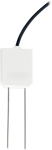
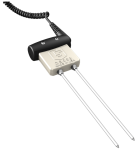
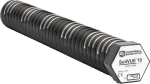
The CS650 consists of two 30-cm-long stainless steel rods connected to a printed circuit board. The circuit board is encapsulated in epoxy and a shielded cable is attached to the circuit board for data logger connection.
The CS650 measures propagation time, signal attenuation, and temperature. Dielectric permittivity, volumetric water content, and bulk electrical conductivity are then derived from these raw values.
Measured signal attenuation is used to correct for the loss effect on reflection detection and thus propagation time measurement. This loss-effect correction allows accurate water content measurements in soils with bulk EC ≤3 dS m-1 without performing a soil specific calibration.
Soil bulk electrical conductivity is also calculated from the attenuation measurement. A thermistor in thermal contact with a probe rod near the epoxy surface measures temperature. Horizontal installation of the sensor provides accurate soil temperature measurement at the same depth as the water content. Temperature measurement in other orientations will be that of the region near the rod entrance into the epoxy body.
Compatibility
Note: The following shows notable compatibility information. It is not a comprehensive list of all compatible or incompatible products.
Data Loggers
| Product | Compatible | Note |
|---|---|---|
| CR1000 (retired) | ||
| CR1000X (retired) | ||
| CR300 (retired) | ||
| CR3000 (retired) | ||
| CR310 | ||
| CR350 | ||
| CR6 | ||
| CR800 (retired) | ||
| CR850 (retired) |
Additional Compatibility Information
RF Considerations
External RF Sources
External RF sources can affect the probe’s operation. Therefore, the probe should be located away from significant sources of RF such as ac power lines and motors.
Interprobe Interference
Multiple CS650 sensors can be installed within 4 inches of each other when using the standard data logger SDI-12 “M” command. The SDI-12 “M” command allows only one probe to be enabled at a time.
Installation Tool
The CS650G makes inserting soil-water sensors easier in dense or rocky soils. This tool can be hammered into the soil with force that might damage the sensor if the CS650G were not used. It makes pilot holes into which the rods of the sensors can then be inserted.
Specifications
| Measurements Made | Soil electrical conductivity (EC), relative dielectric permittivity, volumetric water content (VWC), soil temperature |
| Required Equipment | Measurement system |
| Soil Suitability | Long rods with large sensing volume (> 6 L) are suitable for soils with low to moderate electrical conductivity. |
| Rods | Not replaceable |
| Sensors | Not interchangeable |
| Sensing Volume | 7800 cm3 (~7.5 cm radius around each probe rod and 4.5 cm beyond the end of the rods) |
| Electromagnetic |
CE compliant Meets EN61326 requirements for protection against electrostatic discharge and surge. |
| Operating Temperature Range | -50° to +70°C |
| Sensor Output | SDI-12; serial RS-232 |
| Warm-up Time | 3 s |
| Measurement Time | 3 ms to measure; 600 ms to complete SDI-12 command |
| Power Supply Requirements | 6 to 18 Vdc (Must be able to supply 45 mA @ 12 Vdc.) |
| Maximum Cable Length | 610 m (2000 ft) combined length for up to 25 sensors connected to the same data logger control port |
| Rod Spacing | 32 mm (1.3 in.) |
| Ingress Protection Rating | IP68 |
| Rod Diameter | 3.2 mm (0.13 in.) |
| Rod Length | 300 mm (11.8 in.) |
| Probe Head Dimensions | 85 x 63 x 18 mm (3.3 x 2.5 x 0.7 in.) |
| Cable Weight | 35 g per m (0.38 oz per ft) |
| Probe Weight | 280 g (9.9 oz) without cable |
Current Drain |
|
| Active (3 ms) |
|
| Quiescent | 135 µA typical (@ 12 Vdc) |
Electrical Conductivity |
|
| Range for Solution EC | 0 to 3 dS/m |
| Range for Bulk EC | 0 to 3 dS/m |
| Accuracy | ±(5% of reading + 0.05 dS/m) |
| Precision | 0.5% of BEC |
Relative Dielectric Permittivity |
|
| Range | 1 to 81 |
| Accuracy |
|
| Precision | < 0.02 |
Volumetric Water Content |
|
| Range | 0 to 100% (with M4 command) |
| Water Content Accuracy |
|
| Precision | < 0.05% |
Soil Temperature |
|
| Range | -50° to +70°C |
| Resolution | 0.001°C |
| Accuracy |
|
| Precision | ±0.02°C |
Documents
Brochures
Manuals
Technical Papers




Downloads
To find previously purchased software downloads, log in to the website using the same account the software was purchased under. Navigate to the account's Purchased Software section.
CS650 / CS655 Firmware v.2 (429 KB) 12-02-2015
Current CS650 and CS655 firmware.
Note: The Device Configuration Utility and A200 Sensor-to-PC Interface are required to upload the included firmware to the sensor.
Frequently Asked Questions
Number of FAQs related to CS650: 50
Expand AllCollapse All
-
The electrical conductivity (EC) of sea water is approximately 48 dS/m. The CS650 can measure permittivity in water with EC between 0 and 3 dS/m. EC readings become extremely unstable at conductivities higher than 3 dS/m and are reported as NAN or 9999999. Because EC is part of the permittivity equation, an EC reading of NAN leads to a permittivity reading of NAN as well. Thus, the CS650 cannot provide good readings in sea water.
With regard to sea ice, the electrical conductivity drops significantly when sea water freezes and the permittivity changes from approximately 88 down to approximately 4, as the water changes from a liquid to a solid state. With both EC and permittivity falling to levels that are within the CS650 measurement range, the sensor is expected to give valid readings in sea ice. The sensor is rugged and can withstand the cold temperatures. However, as the ice melts, there will be a point at which the electrical conductivity becomes too high to acquire a valid reading for either permittivity or electrical conductivity.
-
Campbell Scientific does not recommend using the CS650 or the CS655 to measure water content in compost. A compost pile is a very hostile environment for making dielectric measurements with soil water content sensors. All of the following combine to make it very difficult to determine a calibration function: high temperature, high and varying electrical conductivity, high organic matter content, heterogeneity of the material in the pile, changing particle size, and changing bulk density. The temperature and electrical conductivity values reported by the CS650 or CS655 may give some useful information about processes occurring in the compost pile, but these sensors will not be able to give useful readings for water content.
-
In soil that has a significant fraction of fines (loam, silt loam, silty clay loam, clay loam, clay), the CS655 is a suitable option because these soils tend to be more electrically conductive, and the CS655 operates over a larger range of electrical conductivity than the CS650. In applications where a smaller measurement volume is desired, such as larger greenhouse pots, the 12 cm long rods of the CS655 are preferable to the 30 cm long rods of the CS650.
-
The bulk electrical conductivity (EC) measurement is made along the sensor rods, and it is an average reading of EC over that distance at whatever depth the rods are placed.
-
Campbell Scientific does not recommend splicing sensor cables. Sensors may be ordered with custom cable lengths, and Campbell Scientific recommends purchasing the correct length for the application. If the sensor cable needs to be lengthened, a junction box (if practical) is a more favorable option than a splice.
Note: A splice will void the sensor warranty, but a junction box does not modify the sensor and therefore does not void the warranty.
-
Modifications to the CS650 or CS655, including shortening the cable, will void the warranty. However, shortening the cable will not affect the sensor’s performance. If a decision is made to shorten the cable, care should be taken to avoid damaging the cable jacket and exposing bare wire except at the ends that connect to the data logger or multiplexer terminals.
-
Mine tailings are highly corrosive and have high electrical conductivity. Some customers have successfully used water content reflectometers, such as the CS650 or the CS655, to measure water content in mine tailings by coating the sensor rods with heat-shrink tubing. This affects the sensor output, and a soil-specific calibration must be performed. Care must be taken during installation to avoid damaging the heat-shrink tubing and exposing the sensor’s rods. In addition, covering the sensor’s rods invalidates the bulk electrical conductivity reading. Unless the temperature reading provided by the CS650 or the CS655 is necessary, a better option may be to use a CS616 with coated rods.
-
The permittivity of saturated sediments in a stream bed is expected to read somewhere between 25 and 42, while the permittivity of water is close to 80. A CS650 or CS655 installed in saturated sediments could be used to monitor sediment erosion. If the permittivity continuously increases beyond the initial saturated reading, this is an indication that sediment around the sensor rods has eroded and been replaced with water. A calibration could be performed that relates permittivity to the depth of the rods still in the sediment.
-
The CS650 and the CS655 are not ideal sensors for measuring water level. However, these sensors do respond to the abrupt change in permittivity at the air/water interface. A calibration could be performed to relate the period average or permittivity reading to the distance along the sensor rods where the air/water interface is located. From that, the water level can be determined. The permittivity of water is temperature dependent, so a temperature correction would be needed to acquire accurate results.
-
No. The abrupt permittivity change at the interface of air and saturated soil causes a different period average response than would occur with the more gradual permittivity change found when the sensor rods are completely inserted in the soil.
For example, if a CS650 or a CS655 was inserted halfway into a saturated soil with a volumetric water content of 0.4, the sensor would provide a different period average and permittivity reading than if the probe was fully inserted into the same soil when it had a volumetric water content of 0.2.
Case Studies

Everglades National Park is the largest tropical wilderness in the United States and was created......read more
Agrivoltaics or dual-use solar is a system combining an agricultural crop (viticulture, arboriculture, field crops,......read more
Articles and Press Releases
Newsletter Articles
Privacy Policy Update
We've updated our privacy policy. Learn More
Cookie Consent
Update your cookie preferences. Update Cookie Preferences